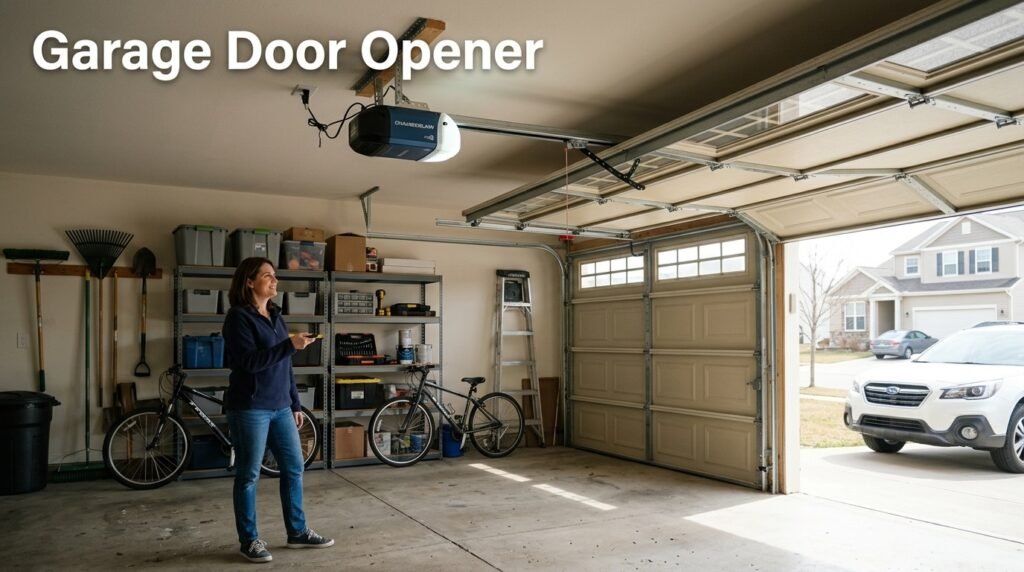
A garage door opener is the motorized system that lifts and lowers your garage door for you. You can control it with a remote, wall button, keypad, or smartphone app instead of lifting the door by hand.
Most residential openers fall into four main categories: chain drive, belt drive, screw drive, and wall-mounted jackshaft. Basic models tend to cost less, while quieter, smart, and wall-mounted options usually cost more.
The right choice depends on a few things: your door’s size and weight, how much noise you can tolerate, your garage layout, and your budget. Here’s how each option works and what to look for before buying.
How Does a Garage Door Opener Actually Work?
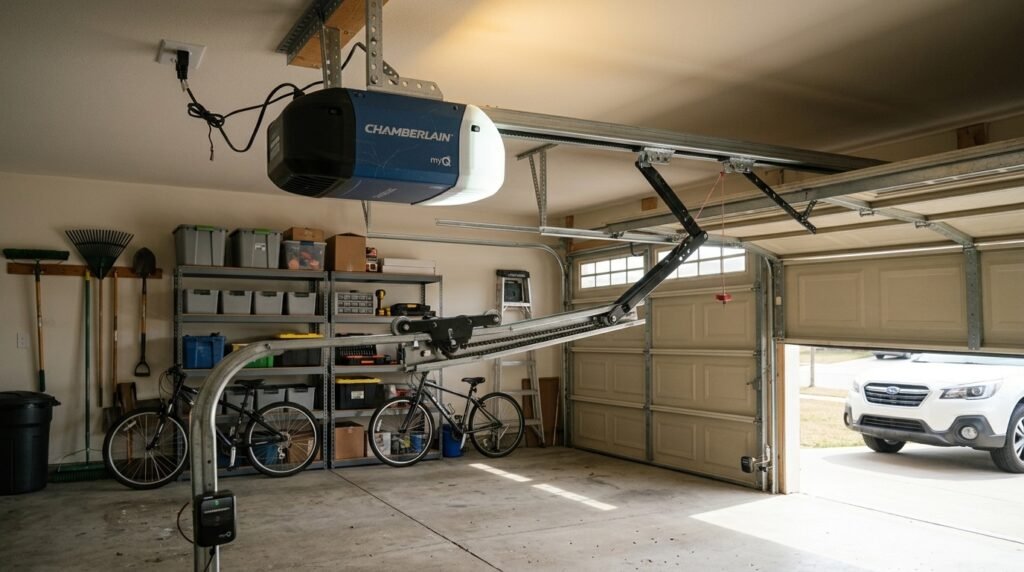
At its core, a garage door opener is pretty simple.
There’s a motor mounted on the ceiling or wall, a drive system that moves the door, and an arm that connects the opener to the garage door. When you press the button, the motor activates the drive mechanism, which moves the trolley or carriage along the rail and pulls the door open or closed.
You’ll also come across AC and DC motors when comparing openers.
AC motors have been used for years and are generally simple and dependable. DC motors are common in newer openers because they can start and stop more smoothly and tend to operate more quietly. DC systems also make battery backup easier to incorporate.
Another specification you’ll see is horsepower (HP). Garage door openers may be listed with ratings such as 1/3 HP, 1/2 HP, 3/4 HP, or higher. But don’t choose an opener based on horsepower alone. The door’s size, weight, balance, and the manufacturer’s compatibility requirements all matter.
Then there are the safety sensors. These are two small sensors mounted near the bottom of the garage door tracks. They create an invisible beam across the door opening. If something interrupts that beam while the door is closing, the opener is designed to stop and reverse the door.
If an older opener lacks modern safety features, it’s worth considering an upgrade rather than simply repairing it.
Types of Garage Door Openers
This is where the biggest differences show up. Each opener type works a little differently, and the right one depends on your garage and what matters most to you.
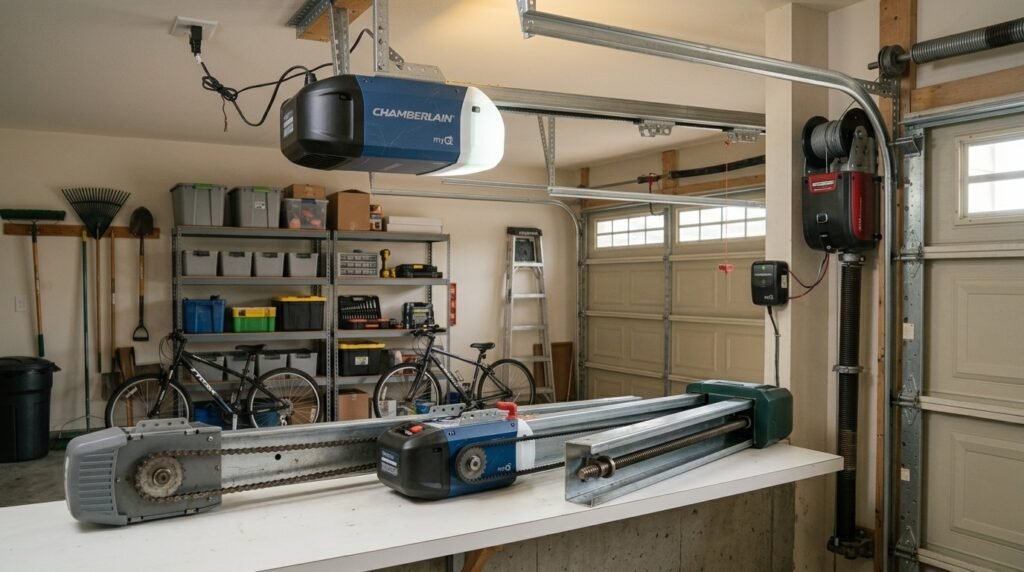
Chain Drive Garage Door Opener
A chain drive opener uses a metal chain to move the trolley along the rail.
It’s the traditional workhorse of garage door openers. Chain drives are generally affordable, dependable, and suitable for many residential garage doors.
The biggest downside is noise. The moving metal chain and vibration from the rail can make a chain opener louder than a belt-drive system.
That may not matter much if you have a detached garage. But if there’s a bedroom, office, or living space directly above or beside the garage, the difference can become noticeable.
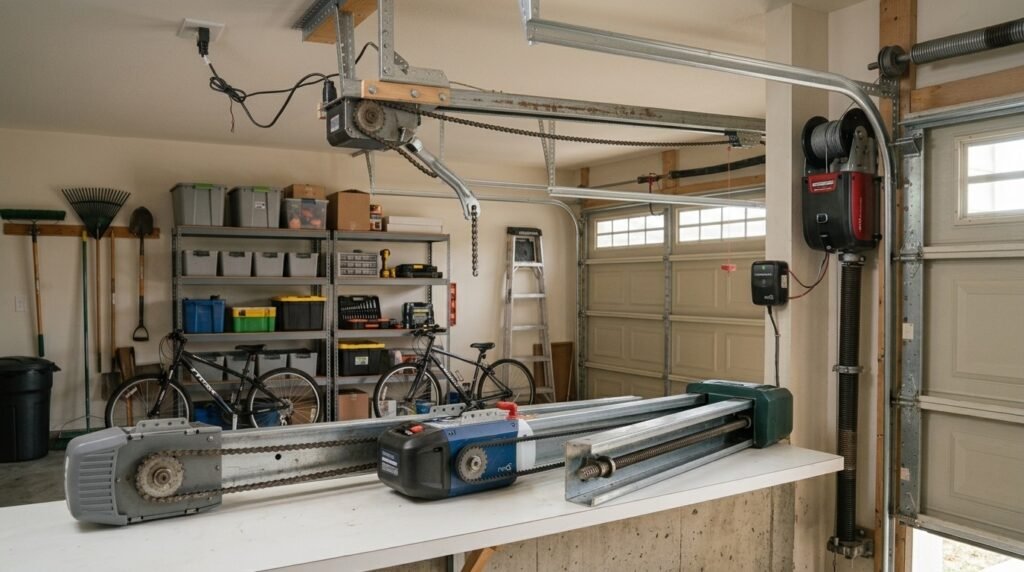
Belt Drive Garage Door Opener
A belt drive opener works in much the same basic way as a chain drive, but it uses a reinforced belt instead of a metal chain.
That change makes a big difference in sound and vibration. Belt drives are generally much quieter, which is why they’re popular for attached garages.
They usually cost more than comparable chain-drive models, but the extra cost can be worthwhile if you use the garage frequently or have living space close by.
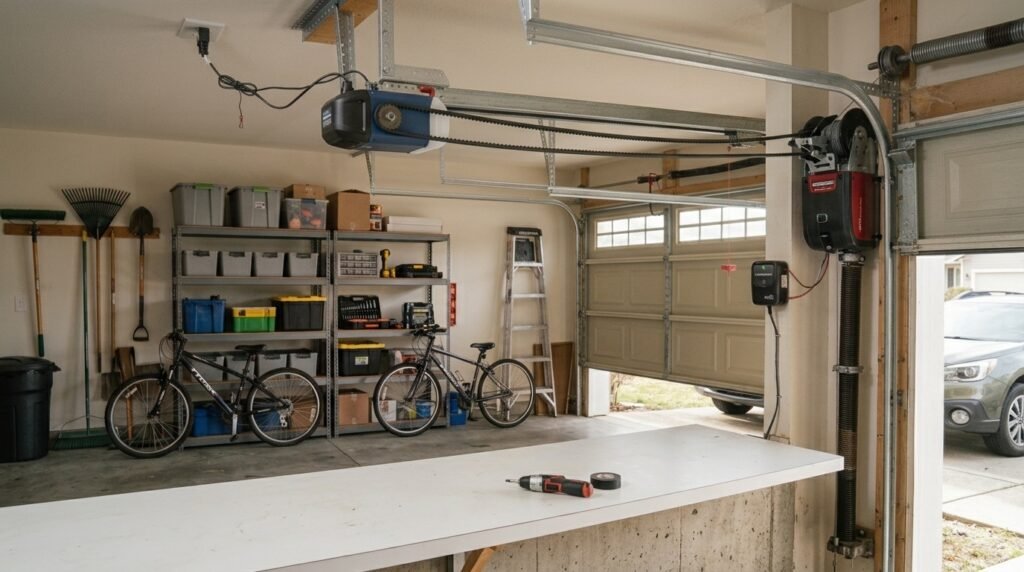
Screw Drive Garage Door Opener
A screw-drive opener uses a threaded steel rod to move the trolley along the rail.
The design has fewer moving parts than some traditional systems, which can mean less routine maintenance. However, performance and noise can vary by model and climate.
Screw-drive systems aren’t as common as they once were, but they can still make sense for certain garages.
Direct-Drive Garage Door Opener
A direct-drive opener uses a different design from a traditional chain or belt opener. Instead of a motor pulling a trolley along a moving chain or belt, the motor itself travels along a stationary rail system to move the door.
Because the design has fewer moving parts, direct-drive systems are known for quiet operation and low maintenance.
They’re usually more expensive than basic chain-drive openers, so the higher upfront cost may not make sense for every garage.
Wall-Mount or Jackshaft Garage Door Opener
A wall-mount, often called a jackshaft opener, mounts beside the garage door instead of hanging from the ceiling.
It connects to the torsion bar that operates the door, eliminating the long overhead rail found on most traditional openers.
That can be a big advantage if your garage has limited ceiling space, overhead storage, a sloped ceiling, or a setup where a ceiling-mounted rail would get in the way.
Wall-mounted openers are also generally quiet because there’s no long overhead rail and trolley moving across the ceiling.
The main drawback is price. They’re typically more expensive than basic ceiling-mounted models, and compatibility depends on the specific garage door and torsion-spring setup.
Quick Comparison
| Type | Noise | Typical Unit Cost | Maintenance |
| Chain Drive | Louder | $150–$250 | Moderate |
| Belt Drive | Quiet | $200–$400 | Low |
| Screw Drive | Moderate | $200–$450 | Low to moderate |
| Direct Drive | Very quiet | $200–$450+ | Low |
| Wall-Mount/Jackshaft | Quiet | $300–$600+ | Low |
These are general price ranges for the opener unit itself, not installation. Actual prices vary by brand, model, features, and location.
How Much Horsepower Do You Actually Need?
Horsepower can be confusing because it’s easy to assume that a heavier garage door automatically needs the highest-rated motor.
That’s not really how it works.
A properly balanced garage door shouldn’t require the opener to do all the heavy lifting. The springs and door hardware are responsible for balancing much of the door’s weight. The opener then moves the balanced door through its travel.
Because of that, door size, weight, balance, construction, and manufacturer specifications matter more than simply choosing the biggest HP number you can find.
As a general starting point:
- 1/3 HP: Often suitable for lighter residential doors, depending on the opener and manufacturer.
- 1/2 HP: A common choice for many standard residential garage doors.
- 3/4 HP: Can be appropriate for heavier doors or certain larger applications.
- 1 HP or higher: Usually reserved for particularly heavy, oversized, or specialty applications.
Don’t automatically upgrade to a larger motor just because your garage door is insulated. Insulation can add weight, but the correct opener still depends on the complete door and opener system.
If you’re replacing an opener, check the manufacturer’s specifications for your specific door size and construction. If the door is difficult to lift manually or doesn’t stay balanced, fix that problem before blaming the opener.
Garage Door Remotes and Smart Controls
The opener itself is only part of the system. How you control it matters too.
- Handheld remote: The traditional garage door opener remote. Many openers include one or more.
- Wall control: A button or control panel mounted inside the garage.
- Wireless keypad: Lets you enter a code from outside without carrying a remote.
- Universal remote: Can be programmed to work with compatible openers from different manufacturers.
- Smartphone app: Allows you to operate the door and, with compatible systems, check its status from your phone.
Smart features can be useful if you want to know whether the garage door was left open or want to control it remotely.
Security is another reason to pay attention to the age of your opener. Modern systems commonly use changing or encrypted codes rather than relying on an old fixed remote code. If your opener is several decades old, upgrading can provide both convenience and newer security features.
How Much Does a Garage Door Opener Cost?
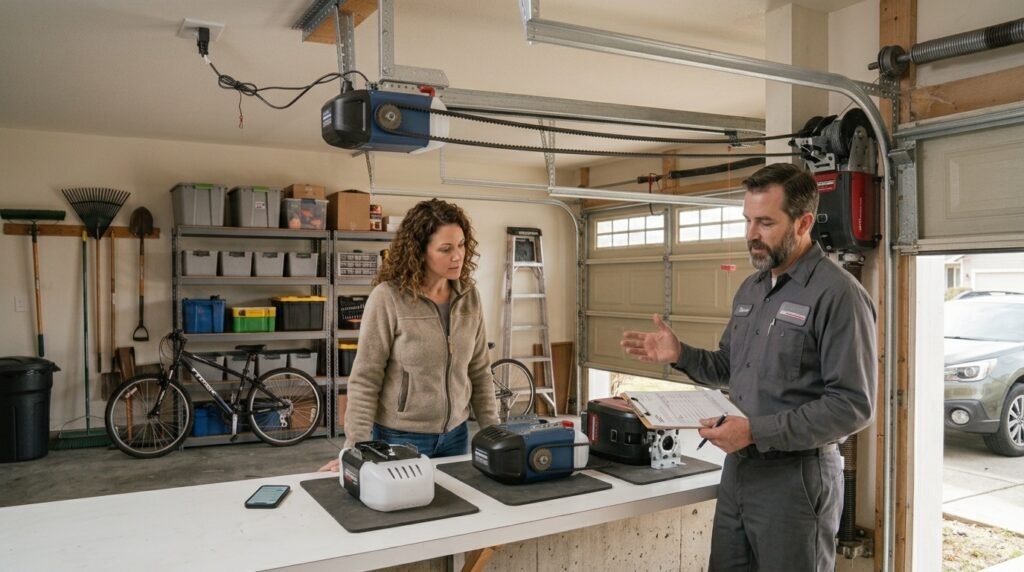
The total price usually comes down to two things: the opener itself and installation.
As a general starting point:
- Opener unit: About $150 to $600 or more, depending on type and features
- Professional installation: Often adds around $100 to $300, although local labor rates vary
- Complete installed system: Many homeowners can expect roughly $250 to $900 or more
Features that can increase the price include:
- Battery backup
- Smartphone or smart-home connectivity
- Higher-capacity motors
- Wall-mounted designs
- Premium belt or direct-drive systems
- Additional remotes or accessories
If your existing opener has failed but the door, track, springs, and other hardware are still in good condition, ask the installer whether you need a complete replacement or only a new opener unit.
However, don’t assume that every existing track or accessory will work with a new opener. Compatibility should be confirmed before reusing old components.
Prices also vary significantly by location and model, so getting two or three local quotes can give you a much better idea of what you’ll actually pay.
Battery Backup: Do You Actually Need It?
Battery backup keeps the opener operating when the home’s power goes out.
That can be more than a convenience if your area experiences frequent storms or power interruptions. You can still manually operate many garage doors using the emergency release, but a battery-backed opener lets you use the motor normally during an outage.
If power outages are rare where you live, battery backup may not be essential. But it’s a useful feature to have, especially if your garage is a primary entrance to the house.
If you do have a battery backup, remember that the battery doesn’t last forever. Check it periodically and replace it according to the manufacturer’s instructions.
DIY Installation vs. Hiring a Professional
Installing a garage door opener yourself is possible if you’re comfortable with basic tools and carefully follow the manufacturer’s instructions.
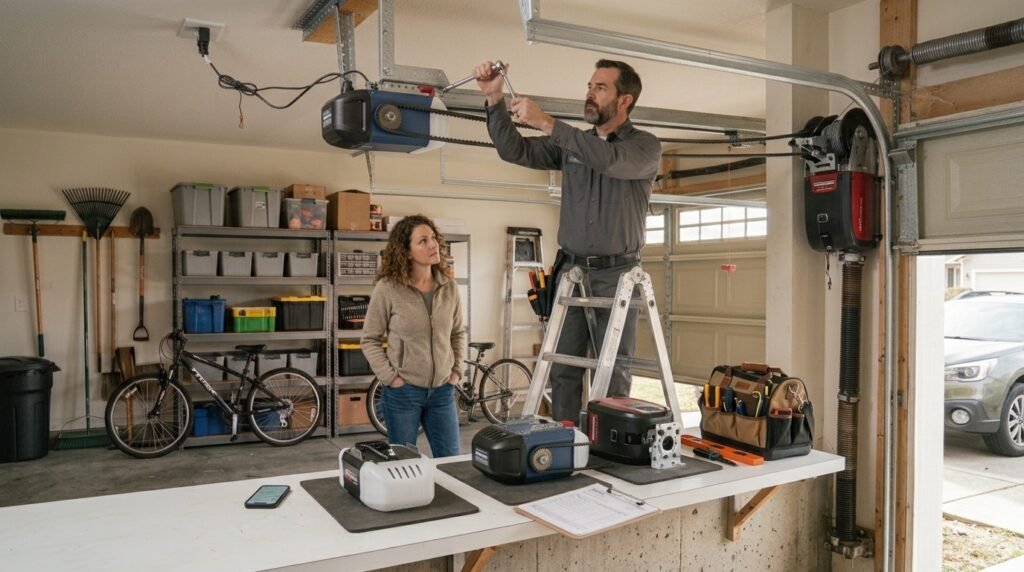
A straightforward replacement can be a reasonable weekend project. But there are situations where professional installation makes much more sense.
Consider professional installation if:
- New electrical work is required
- The ceiling or mounting surface needs modification
- The garage door isn’t properly balanced
- Springs or cables need adjustment
- You’re unsure about opener compatibility
- The manufacturer requires professional installation for warranty coverage
- You simply don’t feel comfortable working around a large moving door
The biggest safety concern is the garage door spring system. Torsion and extension springs can store significant energy. Adjusting or replacing them isn’t a good DIY project for someone without the proper training and tools.
If you’re only replacing the opener and the existing door is properly balanced, the job is much more straightforward. Still, follow the installation manual rather than assuming every opener mounts the same way.
How Long Do Garage Door Openers Last?
A garage door opener commonly lasts around 10 to 15 years, although actual lifespan depends on the model, number of daily cycles, maintenance, environment, and overall use.
Some openers last longer, while heavily used systems may need attention sooner.
Signs that replacement may make more sense than another repair include:
- The opener struggles or strains during normal operation
- The motor makes unusual grinding or squealing sounds
- The opener frequently stops working
- Safety features don’t work properly
- Replacement parts are difficult to find
- Repairs are becoming frequent or expensive
- The unit is very old and lacks modern features you now need
Garage Door Opener Maintenance Checklist
A little maintenance can help your opener operate more reliably.
- Test the auto-reverse system regularly according to the manufacturer’s instructions.
- Check the safety sensors and keep them aligned and free of dust or debris.
- Inspect the mounting hardware and tighten loose bolts when necessary.
- Listen for changes in sound. New grinding, rattling, or squealing can be an early warning sign.
- Inspect the rail and moving components for obvious wear or damage.
- Check the battery backup if your opener has one.
- Lubricate only the parts specified by the manufacturer. Don’t assume every chain, belt, rail, or component needs the same lubricant.
How to Choose the Right Garage Door Opener for Your Garage
There’s no single opener that’s perfect for every homeowner. Start with your garage layout and how you use the door.
- Noise is your biggest concern: Look at belt, direct-drive, or suitable wall-mounted models.
- You want to spend less upfront: A chain-drive model is often the most budget-friendly choice.
- You have a heavier or larger door: Check the manufacturer’s door-size and weight requirements rather than choosing based on HP alone.
- Ceiling space is limited: A wall-mount/jackshaft opener may be the better solution.
- You want low maintenance: Belt, direct-drive, and some screw-drive systems can be good options.
- You want smart features: Look for an opener with built-in Wi-Fi or confirmed compatibility with the smart-home system you use.
- You experience frequent power outages: Consider a model with battery backup.
The Bottom Line
Choosing the right garage door opener doesn’t have to be complicated. Start with your door’s size and condition, then think about noise, ceiling space, features, and budget.
Chain drives are a solid choice when keeping the upfront cost down matters most. Belt and direct-drive systems are better suited to homeowners who want quieter operation. Wall-mounted jackshaft openers can be especially useful when ceiling space is limited.
Most importantly, don’t choose an opener based on horsepower alone. Make sure the opener is rated for your specific door and that the door itself is properly balanced and maintained.
Get those basics right, and you can choose an opener that fits your garage instead of paying extra for features you don’t actually need.
Frequently Asked Questions About Garage Door Openers
What type of garage door opener is best?
There isn’t one best type for every garage. Chain-drive openers are usually a good choice when upfront cost matters, while belt and direct-drive models are better if quiet operation is important. Wall-mounted jackshaft openers can make sense when ceiling space is limited.
How much does it cost to install a garage door opener?
A garage door opener typically costs about $150 to $600 or more for the unit, while professional installation may add another $100 to $300. Your actual cost depends on the opener type, features, labor rates, and whether any additional work is needed.
Is a belt-drive opener better than a chain-drive opener?
Not necessarily. A belt-drive opener is generally quieter and produces less vibration, which can be helpful in an attached garage. A chain-drive opener usually costs less and can be a practical choice when noise isn’t a major concern.
How long does a garage door opener usually last?
Many residential garage door openers last around 10 to 15 years. Actual lifespan depends on the opener’s quality, how often the door is used, maintenance, and the condition of the garage door and hardware.
What horsepower garage door opener do I need?
It depends on your garage door’s size, weight, construction, balance, and the opener manufacturer’s specifications. A 1/2 HP opener is common for many residential applications, but larger or heavier doors may require a different rating.
Do garage door openers work when the power is out?
An opener with a battery backup can continue operating during a power outage. Without battery backup, you can usually disconnect the opener using the emergency release and operate a properly balanced garage door manually.
Can I install a garage door opener myself?
Yes, a straightforward opener replacement can be a DIY project if you’re comfortable using tools and following the manufacturer’s instructions. However, spring, cable, or electrical work can be dangerous and is better left to a qualified professional.
When should I replace my garage door opener instead of repairing it?
Replacement may make more sense when the opener is very old, repairs are becoming frequent, replacement parts are difficult to find, or important safety features aren’t working properly. Minor problems such as a dirty sensor or dead remote battery may only require a simple fix.